Posts

Comparison between tract and nerve

  Comparison between tract and nerve Nerve Nerve contain bundle of axons (nerve fibers) in the peripheral nervous system (PNS) that transmits signals between the central nervous system (CNS) and other parts of the body. It is the most important part of peripheral nervous system Location: Peripheral nervous system. Structure: Made of axons, connective tissue layers (endoneurium: axon is surrounded by it , perineurium: bundle of axons are surrounded by it, epineurium: whole nerve trunk is surrounded by it), and blood vessels. It gets myelination by Schwann cell   Function: Carries sensory signals to the CNS (afferent) from peripheral part of body or motor signals carry from from the CNS (efferent) to target organs like skeletal muscle, cardiac muscle, smooth muscle or glands Example: Sciatic nerve, median nerve, except optic nerve (though optic nerve is technically part of CNS in develop...
Difference between location, functions & development of different skin cells

  Difference between location, functions & development of different skin cells Cells of skin Location Functions Development Keratinocytes stratum basale  It forms barrier against environmental damage by heat, UV radiation, dehydration, pathogenic bacteria, fungi, parasites, and viruses. Surface ectoderm Melanocytes Stratum basale Melanocytes are well known for their role in skin pigmentation, and their ability to produce and distribute melanin has been studied extensively Neural crest Langerhans cells Stratum spinosum These cells act as the outermost guard of the cutaneous immune system and are likely to induce the first reactions against pathogens encountered via the skin Fetal Langerhans cells from Primitive yolk sac in fetal life , in adult Langerhans cells   from feta...

Difference between development of ovary and testis

Difference between development of ovary and testis                                                                Development of ovary   1.         intermediate mesoderm form urogenital ridge, a longitudinal elevation at the dorsal body wall of fetus 2.        The coelomic epithelium and underlying mesoderm of the urogenital ridge proliferate to form the gonada ridge 3.        The coelomic epithelium forms irregular primary sex cords and incorporate primordial germ cells which migrate from the wall of yolk sac 4.        The primary sex cord extends deep to medulla and dissociate into irregular cell clusters which eventually degenerate and replace by vascular stroma, the ovarian medulla. 5. ...

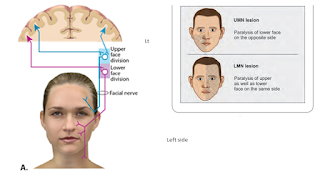
Bell palsy vs facial palsy due to stroke

Image
  Bell palsy vs facial palsy due to stroke   The two most common causes of acute facial paralysis are Bell’s palsy and ischemic stroke Facial weakness can be caused by strokes in many different locations in the brain and brainstem. Strokes involving the brain typically cause central facial weakness that involves the mouth and spares the eye and forehead. Strokes involving the brainstem can sometimes cause weakness of the mouth, eye and forehead–mimicking a peripheral lesion. In these cases however, there will be other focal neurologic deficits. A review of systems and neurologic examination can help to identify signs and symptoms of stroke. Bell's palsy is  a condition that causes sudden weakness in the muscles on one side of the face . In most cases, the weakness is temporary and significantly improves over weeks. The weakness makes half of the face appear to droop. Smiles are one-sided, and the eye on the affected side resists closing. Bell palsy vs facial palsy du...

difference between rough endoplasmic reticulum and smooth endoplasmic reticulum

Image
difference between rough endoplasmic reticulum and smooth endoplasmic reticulum

Difference between somitomere and somite of paraxial mesoderm

Image
  Difference between somitomere and somite Somitomeres and Somites: Key Differences and Development Both somitomeres and somites originate from the paraxial mesoderm and play crucial roles in the formation of the axial skeleton, muscles, and dermis.  1. Somitomeres 🔹 Definition: Somitomeres are loose masses of mesoderm that appear in a cranial-to-caudal sequence along the embryonic axis before forming somites. 🔹 Characteristics: First seen in the paraxial mesoderm during the third week of development. Less organized than somites. Found in the head and neck region (first 7 pairs do not form somites). Contribute to craniofacial muscles, pharyngeal arches, and extraocular muscles . 🔹 Fate: The first 7 pairs contribute to head and neck structures . Caudal somitomeres condense into somites in the occipital and trunk regions. 2. Somites 🔹 Definition: Somites are well-organized, paired blocks of mesoderm that develop from somitomeres in the occipital to sacral regio...

Difference between general sensation and special sensation

Image
  Difference between general sensation and special sensation General and Special Sensations in the Nervous System The nervous system processes different types of sensations through the somatic and special sensory pathways . These sensations help us interact with our environment and maintain body functions. 1. General Sensation 🔹 Definition: General sensation refers to the sensations perceived from the skin, muscles, joints, and internal organs . 🔹 Pathway: Carried by the somatic sensory system via the spinal cord and brainstem . 🔹 Types: Exteroception (External Sensation) → From the skin Touch (Fine & Crude) Pressure Temperature (Hot & Cold) Pain (Nociception) Proprioception (Position Sense) → From muscles, tendons, and joints Joint Position Sense Vibration Sense Kinesthesia (Movement Awareness) Visceral Sensation → From internal organs Distension of organs (e.g., stomach, bladder) Pain from ischemia or inflammation 2. Special Sensation 🔹 Definition: Special se...

Difference between alar plate and basal plate of the mantle layer of neural tube

  Difference between alar plate and basal plate  of the mantle layer of neural tube Alar plate Basal plate The  alar plates  (or  alar lamina ) is a neural structure in the embryonic nervous system. Sensory area in the dorsal region of the spinal cord and brain In the developing  nervous system , the  basal plate  is the region of the  neural tube  ventral to the  sulcus limitans they develops from dorsal aspect of mantle layer of neural tube they develops from ventral   aspect of mantle layer of neural tube Functional components deal by alar plate :    Cells within the alar plate develop into afferent and interneurons. The alar plate further develops general sensory afferents (GSA) innervating the skin, special sensory afferents (SSA) innervating the branchial arch derivatives, and visceral sensory af...