Posts

Showing posts from June, 2022

Comparison between tract and nerve

  Comparison between tract and nerve Nerve Nerve contain bundle of axons (nerve fibers) in the peripheral nervous system (PNS) that transmits signals between the central nervous system (CNS) and other parts of the body. It is the most important part of peripheral nervous system Location: Peripheral nervous system. Structure: Made of axons, connective tissue layers (endoneurium: axon is surrounded by it , perineurium: bundle of axons are surrounded by it, epineurium: whole nerve trunk is surrounded by it), and blood vessels. It gets myelination by Schwann cell   Function: Carries sensory signals to the CNS (afferent) from peripheral part of body or motor signals carry from from the CNS (efferent) to target organs like skeletal muscle, cardiac muscle, smooth muscle or glands Example: Sciatic nerve, median nerve, except optic nerve (though optic nerve is technically part of CNS in develop...
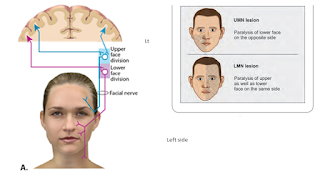
Bell palsy vs facial palsy due to stroke

Image
  Bell palsy vs facial palsy due to stroke   The two most common causes of acute facial paralysis are Bell’s palsy and ischemic stroke Facial weakness can be caused by strokes in many different locations in the brain and brainstem. Strokes involving the brain typically cause central facial weakness that involves the mouth and spares the eye and forehead. Strokes involving the brainstem can sometimes cause weakness of the mouth, eye and forehead–mimicking a peripheral lesion. In these cases however, there will be other focal neurologic deficits. A review of systems and neurologic examination can help to identify signs and symptoms of stroke. Bell's palsy is  a condition that causes sudden weakness in the muscles on one side of the face . In most cases, the weakness is temporary and significantly improves over weeks. The weakness makes half of the face appear to droop. Smiles are one-sided, and the eye on the affected side resists closing. Bell palsy vs facial palsy du...